
The Best Fluffy Pancakes recipe you will fall in love with. Full of tips and tricks to help you make the best pancakes.

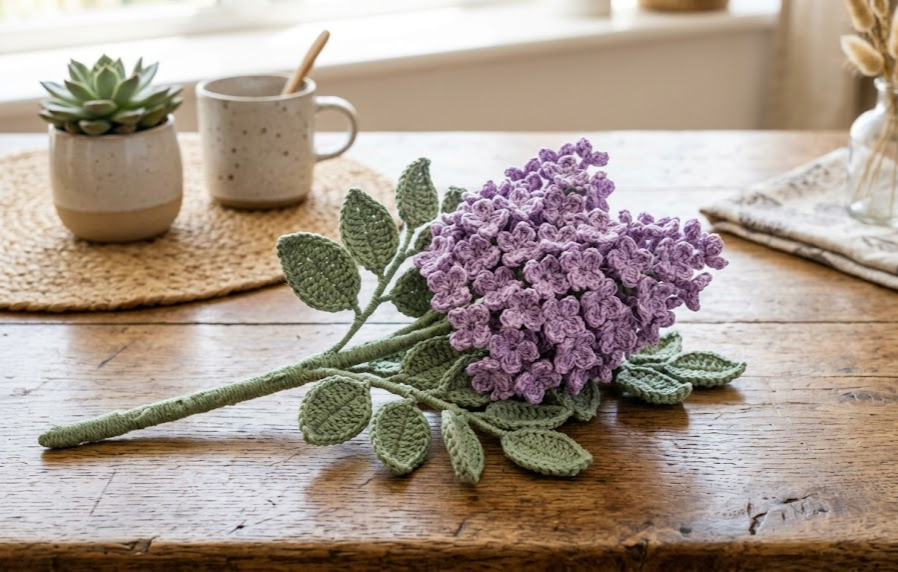
If you’ve ever wished spring lasted a little longer, this crochet lilac flower cluster is the answer. Made up of dozens of tiny five-petal florets gathered onto a single leafy stem, this pattern captures the soft, cascading look of a real lilac bloom without ever needing a vase of water. It’s an ideal project for anyone who loves working small, repetitive motifs — the kind of pattern you can pick up during a coffee break and set down again without losing your place. Beginners will appreciate that each floret uses just two simple rounds, while more experienced crocheters can enjoy the meditative rhythm of building a full cluster petal by petal. Once finished, this piece works beautifully as a standalone stem in a bud vase, tucked into a larger crochet bouquet, or turned into a brooch or hair clip. Let’s get into the details.
|
Difficulty
Beginner-Intermediate
|
Time
4-5 hours
|
Hook Size
2.25mm (B/1)
|
Yarn Weight
DK / Sport (3)
|
Finished Size
~25cm tall
|
Gauge
Gauge is not critical for this project since the florets are small individual motifs rather than a fabric panel, but it’s still useful to check before you begin so your flowers come out a consistent, proportional size.
- 20 single crochet stitches and 22 rows = 10cm x 10cm square, worked in DK weight yarn with a 2.25mm hook
- Each individual floret measures approximately 1cm across when complete
- If your florets are coming out noticeably larger or smaller than 1cm, adjust your hook size up or down by 0.25mm
Materials List
- DK or Sport weight yarn (light worsted, category 3) in Lilac Purple — approximately 30g
- Small amount of the same weight yarn in Lavender (a lighter purple) for shade variation — approximately 10g
- DK or Sport weight yarn in Sage Green for leaves and calyxes — approximately 20g
- 2.25mm (B/1) crochet hook
- Tapestry needle for weaving in ends
- Sharp scissors
- Floral stem wire or green paper-wrapped floral wire (18-22 gauge), one 30cm length
- Floral tape (green)
- Fiberfill or craft glue (optional, for securing stem base)
Abbreviations
| Abbreviation | Meaning |
|---|---|
| ch | chain |
| sc | single crochet |
| sl st | slip stitch |
| dc | double crochet |
| mr | magic ring |
| rep | repeat |
| FO | fasten off |
| BLO | back loop only |
| sk | skip |
| st(s) | stitch(es) |
Pattern Instructions
Part 1: Small Floret (make 30)
Work in Lilac Purple for two-thirds of your florets and Lavender for the remaining third, to create natural color variation across the cluster.
Round 1: Make a magic ring (mr — a technique where you loop yarn around your fingers and crochet into the loop, then pull the tail to close the center tightly, leaving no gap). Ch 1 (does not count as a stitch), 5 sc into the ring. Pull tail to close ring, sl st to first sc to join. (5 sts)
Round 2: *Ch 3, sl st into the 3rd chain from hook (working back down the chain you just made — insert your hook into the third bump from your hook, not the loop), sl st into the next sc on the base circle, rep from * around all 5 stitches. This forms 5 individual petals. FO, leaving a 15cm tail for attaching to the stem.
Repeat this floret 30 times total.
Part 2: Leaf (make 6)
Row 1: Ch 10 in Sage Green. Starting in the 2nd chain from hook, sc in next 2 ch, dc in next 5 ch, sc in last ch. Rotate to work down the opposite side of the starting chain (this means flipping the chain over to crochet along the unused bottom loops, creating a symmetrical leaf shape): sc in next ch, dc in next 5 ch, sc in last 2 ch. Sl st to first sc to close. FO, leaving a 10cm tail. (18 sts total around leaf edge)
Repeat for 6 leaves.
Part 3: Stem Wrap
Cut a 30cm length of floral wire. Starting 2cm from one end, wrap floral tape tightly around the wire at a slight diagonal angle, stretching the tape slightly as you go so it seals to itself. Continue wrapping until the full 30cm length is covered, leaving the final 2cm unwrapped for anchoring into a base later.
Assembly Steps
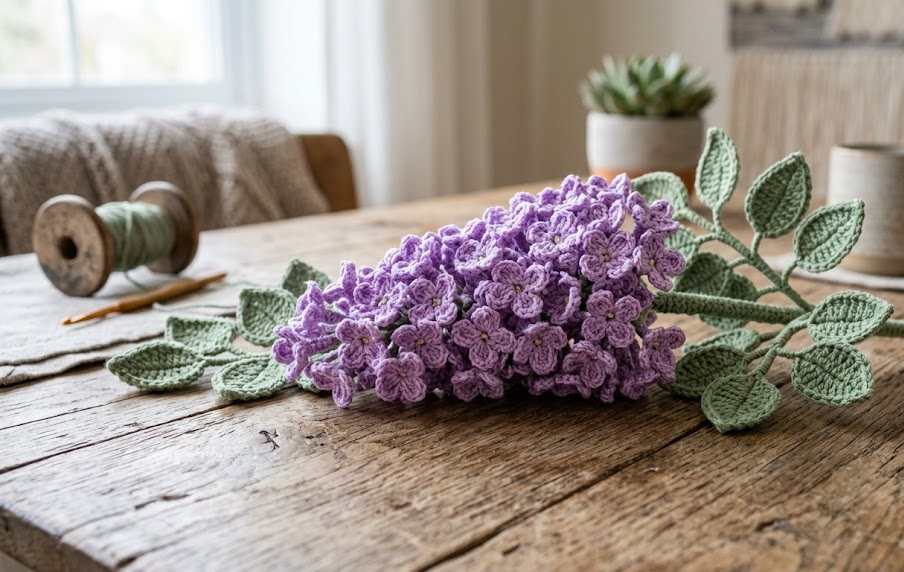
- Lay your wrapped stem wire flat. Starting 3cm from the top end, begin attaching florets using their yarn tails, tying each one snugly against the wire with a double knot and trimming excess tail to 1cm.
- Attach florets in small clusters of 3-4, spaced roughly 0.5cm apart, working down 15cm of the stem. Alternate Lilac Purple and Lavender florets randomly for a natural gradient look.
- Once all 30 florets are attached, wrap a fresh strip of floral tape around the base of each cluster point to secure the tails and smooth the stem’s appearance.
- Attach the 6 leaves along the lower 8cm of the stem, spacing them 1.5-2cm apart and angling them outward at roughly 45 degrees. Secure each leaf tail with a knot, then cover with floral tape.
- If displaying in a vase, the bare 2cm at the stem’s base can be dipped in craft glue or pressed into a small piece of fiberfill to help it stand upright and stay in place.
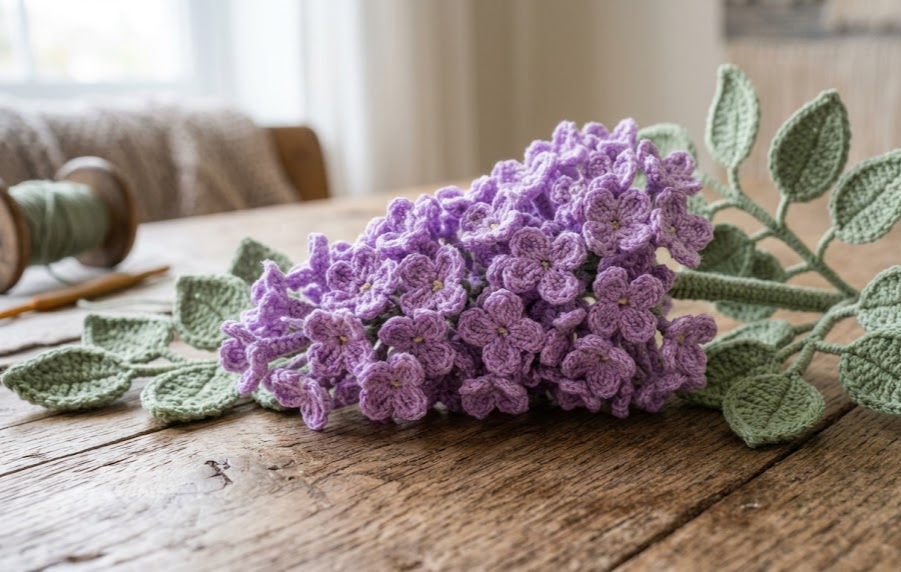
- Gently shape the floret cluster into a loose cone shape by hand, mimicking the natural taper of a real lilac bloom — fuller at the base, narrower at the tip.
Beginner/Intermediate Tips
- Keep your magic ring tension even across all 30 florets — a loose center will make some flowers look bigger than others.
- Use a smaller hook (2mm) for the outer petal round if you want extra-delicate, lace-like petals.
- Work florets in batches of 5-10 at a time rather than all 30 at once — it keeps the repetitive motif from feeling tedious.
- When wrapping floral tape, warm it slightly between your fingers first; this makes it stretch and seal more easily.
- Steam-block finished florets lightly with a handheld steamer to help the petals relax and open if they’re curling inward.
Variations
- White Lilac: Swap the purple and lavender yarn for white and pale cream for a classic white lilac look, perfect for spring wedding décor.
- Mini Bouquet: Make 3-5 stems and gather them together with a ribbon-wrapped base for a full table centerpiece bouquet.
- Brooch Version: Skip the stem wire entirely and glue a finished floret cluster directly onto a pin backing for a wearable floral brooch.
- Ombre Cluster: Use three shades — deep purple at the base of the cluster, medium lilac in the middle, and pale lavender at the tip — for a gradient effect.
- Potted Lilac Tree: Attach multiple stems into a small terracotta pot filled with floral foam for a permanent potted lilac display.
Save This Pattern
This lilac flower cluster is one of those projects that looks far more complicated than it actually is — just small repeated motifs building into something beautiful. Save this pin so you can come back to it next time you need a quick, satisfying floral project. #FoodieRippleCrochet